Posts

NYS Early Intervention Program makes up more rule changes as they trip along

Here is an illustration for providers in the NYS Early Intervention Program that clearly illustrates the selfish orientation of thinking that is driving decision making on a central level at the Bureau of Early Intervention. Exactly two months and two days ago, the Bureau of Early Intervention instructed providers to "accept claim amounts proposed by the insurer as payment in full from the insurer for the claim which are lower than the State-established EIP rate."  Although they explained that this would not impact payments from escrow in the short term, we explained that accepting these payments in this way would be problematic because of the long term intent of having providers accept payments directly from insurers. TODAY we received a DIFFERENT set of instructions from the Bureau of Early Intervention that states: Dear Colleague: The Department is aware that insurers or insurer clearinghouses (Multiplan, Omni Plan) have sent expedited agreeme...

New York State Early Intervention: Roadmap through the end of 2013

My email box is flooded from colleagues asking about the NYS Early Intervention program - so I thought I would lay out the likely path toward the end of 2013 so people can plan appropriately for what lies ahead. I also have a roadmap through 2014 and 2015 which will be published as a part of this series.  Stay tuned. Fall, 2013: The already stressed EIP will continue to come apart at the seams.  Payments to providers will continue to be excruciatingly slow and complex.  Even more providers will leave the system creating even longer waiting lists for children and families. There will be no immediate 'fix' because the legislature is out of session until January. Governor Cuomo and his administrative team will continue to blame the insurance industry for the problem and will refuse to acknowledge their own roles in creating the mess.  This will lay the groundwork for insurance reforms that will be introduced next year in the Governor's Budget.  The State w...

Understanding Common Core Standards in two short videos.

Image
Here is everything you need to know about Common Core standards in two short videos: Enjoy!

Early intervention providers: Look the 'Gift Horse' in the mouth please.

I received this in email today: Dear Colleague: The NYS Department of Health (Department) is offering a one-time State safety net payment to Early Intervention providers, and will not proceed to implement the Preliminary Escrow Payment (PEP) proposal due to insufficient county participation.   State safety net payments will be calculated as seventy-five percent of the value of claims submitted to insurers, with the exception of the medical assistance program, in the period April 1, 2013 through July 29, 2013 for which no known payment or denial has been received.  The State safety net payments will be reconciled commencing on October 1, 2013 by assigning to the Department twenty-five percent of each early intervention payment payable from the escrow account until such time as the State safety net payment is fully recovered.  The safety-net payment is a one-time payment made by the State.  All claims submitted by the provider, including those submi...

Note to politicians: Grandstanding on important policy issues does not win votes.

All press is not good press.  Especially when people get distracted from what the primary issues are. In tonight's Capitol Confidential post there is a report that is headlined: "Therapists want to get paid, Tedisco sees 'War on Women.'" The headline I would like to see is: "Children go without important therapy as NYS decimates Early Intervention Program." A parallel example recently was the announced closure of O.D.Heck.  This announcement generated conversation about the plight of union jobs.  What got lost in the shuffle was the important human rights policy of de-institutionalization and the very real fact that there are problems with maintaining appropriate standards of care when we warehouse people who have disabilities. How do concerns with the early intervention program degrade into a headline about the 'war on women"  and grandstanding on some cause du jour???  The cheapening and coarsening of our policy discourse in this way m...

George Barton: Birth and early influences.

Image
George Edward Barton was born on March 7, 1871.  That is a rather dry fact about one of the important founders of the occupational therapy profession - so what can be done to help give it context? Context provides dimension - and if we want to learn a little about George Barton it might be helpful to know a little about his history.  His parents lived in Boston, Massachusetts.   His father was Edward H. Barton, the Secretary and Treasurer of the South Boston Savings Bank.  His mother was Rebecca Duncan (Boynton) Barton. It was difficult to find other information about George Barton's parents, but a rather unexpected pair of portrait photographs were contained in some of his possessions that led me through this investigation.  Here is the first picture: I recognized this photograph; it is an original portrait of Louisa May Alcott - but why would it be in the possession of George Barton?  Louisa May Alcott was born November 29, 1832 and she died on M...

NYS Early Intervention botches billing for commercial insurance too

Today we received notification that some of our early intervention families have been sent our payments for the services we provided to children.  The payments are not supposed to be directed to the families - they are supposed to be directed to the providers or to the State for processing. Based on our private billing experience as an outpatient clinic, it is uncommon for insurance companies to send reimbursements directly to enrollees, but it happens.  Most of the time when the insurance company does this the family hands the checks directly to us.  Unfortunately, some people don't understand what the checks are or in some situations they just view it as a 'payday' from the insurance company and they keep the payments for themselves.  We eventually learn about this after we call the insurance company after a period of non-payment and they tell us that the claims were paid.  Then we are in the awkward position of calling the patient and asking them to pay th...

For Governor Cuomo: A lesson about the nature of the insurance industry

Image
I have used this space as well as our Facebook page to chronicle the ongoing problems with municipal takeover of health care.  The problems with billing and payments to health care providers has gotten a lot of press lately and Governor Cuomo and his administration are taking some very well deserved lumps for their inept management of the Bureau of Early Intervention. There is an apparent inability to understand the nexus of their legislative and regulatory fiats with the corresponding impact on service delivery.  All we get from our government is statements that the problem lies with private insurers that have failed to pay their share of the program's cost. Albany intended to share costs, but they do not intend to share responsibility for their actions that contribute to the problem. What they fail to understand is that when the government burdens a private entity you can count on the fact that there will be push-back from the private entities.  Failing to take th...

More transparency to help in analysis of the NYS Early Intervention Program billing problems

On 7/15/13 I posted about how the interim State Fiscal Agent appeared to be trolling NYS Early Intervention Service Providers for private business. In the interest of transparency, I wanted to update that issue. In the email I referenced how UNYEIP stated that Director Hutton would write financial hardship letters for providers who have not been paid.  I attempted to verify this and the Bureau of Early Intervention would not admit that they would do this; this is the email that I received from them: I was not able to find out anything further about hardship letters.  However, BEI made the announcement below on Friday [referencing how providers can borrow money that the State owes them - cja editorial comment].  Counties must sign and return an agreement to the Department if they choose to participate in the PEP.  Providers must also sign an agreement and return it to the Department if they wish to avail themselves of the PEP if the municipality is partic...

Historical roots of occupational therapy: It is easy to forget

Image
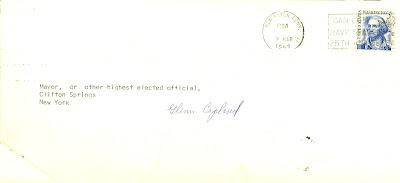
To paraphrase J.R.R. Tolkien... History became legend, legend became myth – and some things that should not have been forgotten … were lost. In Glen Gillen's Slagle lecture at the 2013 AOTA conference he stated "We need to reclaim what we do..."  This is not the first time that there has been a call back to our roots - we periodically re-visit this theme in occupational therapy.  In order for us to develop a plan to 'reclaim what we do' we need to KNOW what we did.  And why we did it.  And what set us on the path to begin with. In a previous entry in this series I showed how Dr. Licht went searching for some of that history.  After receiving a response from Mayor Copeland, Dr. Licht felt like he had struck a gold mine of historical information that he did not previously have: Also, as Dr. Licht had receipt of contact information for Isabel (Newton) Barton, he quickly sent her out a letter as well, eager to lear...

Social Justice: What would Dr. Kielhofner say?

This post is a follow up to my post earlier this month about the use of a public health model for occupational therapy.  The issue of public health models is directly linked to the issue of inclusion of Social Justice in the AOTA Code of Ethics which states (in part): SOCIAL JUSTICE Principle 4. Occupational therapy personnel shall provide services in a fair and equitable manner. Social justice, also called distributive justice, refers to the fair, equitable, and appropriate distribution of resources. The principle of social justice refers broadly to the distribution of all rights and responsibilities in society (Beauchamp & Childress, 2009). In general, the principle of social justice supports the concept of achieving justice in every aspect of society rather than merely the administration of law. The general idea is that individuals and groups should receive fair treatment and an impartial share of the benefits of society. Occupational therapy personnel have a v...

Historical roots of occupational therapy: A beginning explanation for the inquiry.

In the previous installment I talked about the curious letter from Dr. Licht to Dr. Copeland, who was the Mayor of Clifton Springs, NY.  It was curious because Dr. Licht was so closely connected to Dr. Dunton, who was a Founder himself and attended the initial meeting at Consolation House. Looking back at the 50th year celebration of AOTA, we can see that Isabel (Newton) Barton, the wife of George Barton, was alive when Dr. Licht made his initial inquiry in 1967.  She even wrote an article that appeared in AJOT in 1968 about her memories of Consolation House.  This exemplifies the (probable) difficulty of information sharing in a pre-Internet context.  It is difficult to understand any other reason why any 'disconnect' might exist and why Dr. Licht did not contact Mrs. Barton directly from the start. Mrs. Barton's 1968 article is interesting - and primarily reflects a personal recollection of the particulars of Consolation House.  It is dripping full of con...

Historical roots of occupational therapy: Introduction to a series

Image
edit: For those looking for the full series of posts on this topic, please click on the 'History' button on the 'Labels' or use this link. ---------------------------------- I have been sitting on some historical source material for quite some time.  I have been studying the material extensively, trying to decide the best way to share the information, and at times just putting it all aside out of frustration. When students learn about the founding of the occupational therapy profession they tend to read simple information in textbooks and it is somewhat devoid of context.  History without context provides opportunity for misinterpretation, and this is something that I believe is important to try to avoid.  I am not a historian and I am not a biographer and I think this is why I have struggled with how to best present the information.  My motivation was to share this before AOTA's Centennial.  We are well in advance of 2017 and so I hope that be...

More on the NYS 'negotiated' rates and what it might mean for the future of the early intervention program

There was some very important information in the Early Intervention Billing FAQ that was distributed via email today: Q: ­If a provider accepts a lower rate for a payment from an insurance company, the municipality will bear a larger portion of the expense, correct? A: If a provider accepts a negotiated rate of payment and that payment from the insurer is made in an amount less than the State-approved early intervention rate for the service provided, the ISFA will process payments for the balance due the provider from the escrow account using municipal funds at State established rates for the EIP. Billing providers will receive the full EIP rate for delivered services. If the provider does not accept the negotiated rate, and the insurer subsequently denies the claim for reasons such as out of network provider, then the entire payment will be made from the escrow account. We have established a policy to refuse the 'negotiated' rate of payment for home based early interv...

'Occupation' or 'function' as best descriptors for OT practice?

It is too hot to go outside and do anything and I had to shut down my office as we lost power in a (presumed) brownout so I came to my home office and have been trolling around the Internet all afternoon.  That rarely ends productively, but I was really happy to run across some comments from today's #occhat where there was a debate about use of terminology in the profession. I want to strongly encourage people to go read the Letter from the Editor in the Spring 2013 Open Journal of Occupational Therapy written by Diane Powers Dirette . In this letter she discusses issues related to terminology in the field related to use of the words 'occupation' and 'function.' Powers Dirette states that historically OTs have used the word 'function' but this word was replaced with the word 'occupation' in the mid-1990s.  Perhaps not coincidentally, this is the time period when we saw the creation of 'occupational science' as an academic discipline, som...

Emails about early intervention while I was on vacation!

I was on vacation last week and had MANY emails about early intervention and billing in my inbox.  The most interesting one was from Chris Weis who states that he is a product manager for some billing software that is sold by the interim State Fiscal Agent for the NYS Early Intervention program.  It was my favorite email so I thought I would share my response that I copied to the EIP as well.  His initial email is in blockquote below. For background, I will again mention that I think transparency is important and that is why I post this information.  This blog is not chock full of great ideas about treatment activities that kids love.  We provide that elsewhere on our Facebook and Pinterest sites - but this blog format is for communicating serious things.  This information is not for the faint of heart.  It is not intended to celebrate the wonderful job that providers do with children - but it does show how the system is currently threatened - and ma...