Posts

Showing posts with the label history

Occupational Therapy’s Real AI Problem, Part II: When a Chatbot Can’t See the Profession’s Own Ethical History

Image
  I recently wrote that occupational therapy’s real AI problem is not ChatGPT itself, but us. More specifically, it is our profession’s vulnerability to confident, polished, automated explanations built on partial knowledge, private frameworks, and unexamined assumptions. I argued that the real risk is not that a machine will invent nonsense from nowhere, but that it will absorb and amplify the profession’s existing epistemic weaknesses. Now we have Part II of this discussion. I was reminded of this topic when I posed a straightforward question to AOTA’s new chatbot . I asked it "Has there ever been any tension around how to operationalize the ethical principle of social justice in occupational therapy, and what would a violation of that look like in practice?" The answer I received was plausible, polished, but very superficially informed - and thus, fully incorrect. It discussed system barriers, inequities in access, conflicting values, organizational constraints, and the ...

A Living Archive: Twenty Years of Blogging Occupational Therapy

Image
For twenty years, I have used this blog to document occupational therapy as it unfolded: its controversies, contradictions, policy shifts, and unfinished arguments. This archive records my evolving perspective as well as the broader struggles of the profession to define itself. It is not tidy, and it was never meant to be. Sometimes sharp, sometimes uncomfortable, occasionally at odds with what the field preferred to hear, but always honest. The blog has received more than 1.7 million pageviews since 2006, with an estimated 200,000 to 250,000 of those representing real human engagements. That is a remarkable footprint in a small profession where many peer-reviewed articles are read only a few hundred times. Spikes in readership came during inflection points such as the doctoral mandate debate, showing that the blog became a gathering point when the profession was most unsettled. Even in quieter years, thousands still returned, treating the archive as a touchstone for reflection and cr...

WFOT’s New Definition and an Old Tension in OT

Image
The World Federation of Occupational Therapists just released a new definition of occupational therapy. It’s short, clean, and stripped of jargon: “Occupational therapy promotes health and wellbeing by supporting participation in meaningful occupations that people want, need, or are expected to do.” Some commenters online have already begun objecting to the phrase “expected to do,” criticizing it as normative, colonial, or culturally prescriptive. What many don’t seem to realize is that the phrase isn’t new. It’s been in the WFOT definition since at least 2010. The 2025 revision didn’t add this language; it chose not to delete it. That’s significant. A Bit of History Occupational therapy once had role theory as an anchor point. That orientation helped the profession identify what people  should be doing, based on their life stage, culture, and social context. In the 1960s through the 1980s, OT was often described as facilitating participation in the roles of self-care, pro...

When Theory Ignores the Shower Chair

Image
Philosophical thinking has always had value in occupational therapy. It helps us understand the deeper meanings of occupation, the ethics of care, and the cultural assumptions that shape our practice. But philosophy becomes a problem when it detaches from the reality of patient care. Take one example: I once worked with a patient who was Native American and had diabetes complicated by years of substance abuse. He was blind and had bilateral above-knee amputations. His family had limited resources and limited support. They were doing the best they could. And so was I. My plan of care was entirely rooted in his problems—because that's what brought occupational therapy into the picture in the first place. Clinicians don’t have the luxury of deconstructing outcome measures when they’re in a cramped living space, trying to help someone who can’t get into a shower. Rather, they are working with families who are struggling to care for their loved ones under impossible conditions. Tha...

On American Pickers and some homeless treasures of the occupational therapy profession

Image
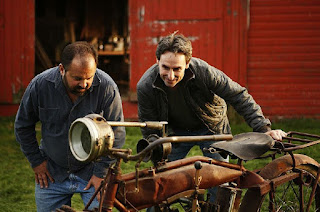
Many people accumulate stuff, and people ascribe varying levels of value to their stuff.  Some people can't part with stuff because of sentimental feelings.  Some people can't part with stuff because it represents a deeper psychological affliction .  We have cultural movements now that address the problematic relationships that people have with their stuff. I initiated an Ebay hobby recently.  There is nothing like the death of parents and the associated task housecleaning that prompts assessment of the value of earthly goods. I have had quite a bit of fun selling things that I no longer wanted. I am a fan of the show ' American Pickers ' and am moved by Mike Wolfe's philosophy about finding things that people no longer wanted and 'putting them into their place' with someone who loved or appreciated them.  That is the flip side of my Ebay hobby - I have also purchased a few things that other people no longer wanted - and in doing so that brings me 'joy....