Posts

The stories we tell ourselves about the past

Image
The concept of narrative captured my interest sometime around 1984 - ironically - because it may have been the Orwell novel with that year's title that prompted my thinking on the topic. I was interested in written narrative and how Winston Smith established his rebellion and then his freedom through a written form (even if it all eventually led to a horrible end). I was also fascinated by his attraction to the paperweight that he purchased - something that was old - and seemingly of unknowable utility. What was the purpose of knowledge, or of the past - except that it all did represent a freedom from the drudgery of the present.  So the paperweight meant something to him, just like his writing meant something. Winston told himself a story about the past.  He created a narrative. As I am on a precipice of decision regarding our private practice I find myself spinning narratives, perhaps to tell myself a story about the past.  I started telling the stories to my wife - may...

The New Fascism in Occupational Therapy

Image
I am sometimes hesitant to extend my commentary to the academic editorializing that happens in the occupational therapy literature of other countries, but I am unable to remain silent.  Too often the ideas expressed elsewhere slither their way into the thinking of academics in the United States. And, of course, any objection to these ideas immediately causes one to be branded xenophobic, and usually worse, so I will simply gird myself for that criticism; I know it is coming.  Over time I have raised the issue of international 'goodness of fit' of philosophical constructs - initially in OT24VX presentations.  I talked about the incompatibility of 'occupational justice' models in societies that had health systems that had elements of free-market construction as opposed to those that are more fully socialized.  For a while I tried to discuss reverse colonialism, thinking that if I spoke the language of those who perceived themselves to be oppressed by Western OT thinki...

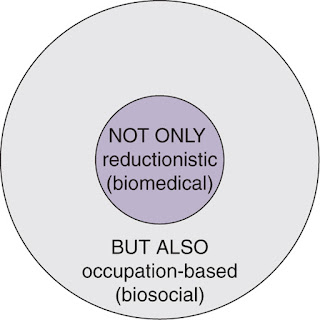
The problems with polarity frames in occupational therapy theory

Image
There is nothing quite like starting off a Monday morning with a good theory article.  I opened up my Twitter feed to find a link to Taff & Putnam's contribution entitled "Northern philosophies and professional neocolonialism in occupational therapy: A historical review and critique." The authors "suggest with confidence that the current American philosophical landscape in 2021 is a mix of mostly analytic philosophy accompanied by a smaller measure of neopragmatism predisposed to a Continental mindset." (Taff & Putnam, 2022).  I am uncertain if this is a view shared by all, and to any degree that it is true, this perspective does not respect an entire heritage of thinking that has been adopted into the American perspective generally and by occupational therapy practitioners specifically. The fact that many occupational therapy practitioners in the United States continue to frame their practice around core American values is a topic that is important to e...

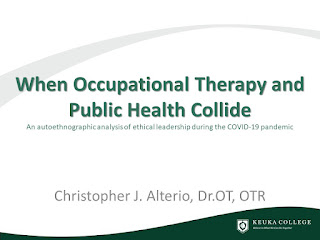
When occupational therapy and public health collide

Image
 Presented at NYSOTA's Annual Conference. 11/13/21 Thanks for stopping by to look at my slides! Click here for slides!

Will the occupational therapy Academic Leadership Council stand up to the accreditation function of its own organization?

Image
  The American Council of Academic Physical Therapy (ACAPT) recently published a paper entitled "Future of physical therapist education programs in higher education."  This paper should be mandatory reading for anyone interested in the proliferation of some allied health programs, credential escalation, and the intersection of these issues with practice. For starters, it is important to disambiguate ACAPT from CAPTE (Commission on Accreditation in Physical Therapy Education) .  CAPTE grants accreditation to entry level programs for the physical therapy profession, and although 'independent' is also a part of the American Physical Therapy Association (APTA) .  ACAPT is a membership association of physical therapy educational programs and their educators.  ACAPT is also an offshoot of the APTA.  This complex relationship makes the ACAPT position statement rather interesting. The ACAPT paper identifies a few key points: 1. There are more PT programs being de...

In search of an evidence-based approach to occupational therapy practice education that would include simulation experiences

Image
  Simulation is a methodology used to replicate real-world tasks.  Simulation provides experiences that lead to direct learning or that can be used as an assessment of competence.  Such tasks have been used as a primary tactic in occupational therapy and other rehabilitation services since their inception - although they were generally applied in a therapeutic context.  For example, an individual would learn how to dress themselves out of context to develop skill, and then that skill would be transferred to contextual learning.  Sometimes, more esoterically, a simulated activity broken down into components would be used to practice parts of tasks that would then be scaffolded in a total practice method.  Either way, simulated experiences are a staple methodology used by occupational therapy professionals for many years. Over time, preferences emerged for 'real-world' and 'contextually-relevant' experience - so much so that entire service delivery systems in...

Best practices for successful OT/OTA partnerships in NYS

Image
  Presented at NYSOTA's Dessert & Dialogue Continuing Education Series, January 5, 2021.  Thanks for stopping by to look at our slides! Click here for slides!

2020 Year in Review: nOT so bad!

Image
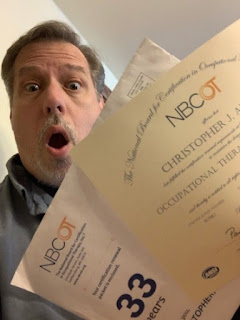
  2020 – An eventful year – pedagogy in a pandemic! Celebrating 33 years of certification as an occupational therapist! A trip to Florida to present on ‘qualitative data sources for narrative analysis’ https://nsuworks.nova.edu/tqrc/eleventh/day1/42/ (last time I have traveled out of New York State) Final photo of me as I left the college in the Spring 2020, optimistic for a quick return! Sample 2020 Blog posts : Alterio, C.J. (2020, January 27). On so-called ‘Civility Pledges’ and the abolition of free thought and free speech.   ABC Therapeutics Blog ,  http://abctherapeutics.blogspot.com/2020/02/on-so-called-civility-pledges-and.html   Alterio, C.J. (2020, March 17). Synchronous vs. asynchronous content delivery in context of COVID-19.   ABC Therapeutics Blog , http://abctherapeutics.blogspot.com/2020/03/synchronous-vs-asynchronous-content.html   Alterio, C.J. (2020, April 12). Immediate action is required to address the crisis in o...

A critique of the concept of 'occupational rights' on Constitution Day 2020

Image
Today is Constitution Day - a good time to reflect on the nature of rights, particularly as this is an apparent topic of interest among some occupational scientists. Many people improperly believe that in an American context rights spring out of the Constitution.  Actually, the so-called Bill of Rights is a list of governmental limitations - or actions that the government can not take against individuals related to their rights.  One of my favorites is the ninth amendment - so limiting in its scope - it states that enumerating any rights in the Constitution shall not be construed to deny or disparage other rights retained by the people. So what is the actual source of these rights?  The American Declaration of Independence states that they are endowed by a Creator - often interpreted as natural rights that are inalienable.   Natural rights were previously identified by John Locke in context of England's Glorious Revolution - identified at the time as the rights ...

Perspectives on motive

Image
  Because we are inherently social, we spend a lot of time trying to understand motive in the actions of others.  Motive provides a context from which we can apply a category or frame - and as we are also inherently driven toward sense-making and meaning-making this idea of motive is a pragmatic tool that actually serves our own purpose. In occupational therapy, a practitioner will take motive out of this standard context and attempt to manipulate it as a tool for promoting a certain outcome.  It is a presumptuous methodology, and probably something that we need to spend time discussing.  Used incorrectly, the manipulation of motive can at best simply backfire, and at worst can actually be an assault on another person's autonomy and freedom.  In either case, if you get it wrong, it ends up being rather unhelpful. +++ We have many squirrels in the neighborhood of our home in the Finger Lakes.  The grandchildren derive endless amusement at watching them - the...

Immediate action is required to address the crisis in occupational therapy fieldwork education caused by the COVID-19 pandemic.

Image
Accreditation is a function that ensures quality in higher education.  Many accreditation functions in higher education are regional, and schools must engage those accreditation processes in order for students attending to be eligible for many forms of financial aid. Many professional educational programs are also accredited by discipline specific organizations , which are in turn themselves monitored by national accreditors .  In sum, there are multiple layers to the educational accreditation process that all serve as a quasi-public protection to ensure quality.  The occupational therapy profession has a discipline specific accreditor, named the Accreditation Council for Occupational Therapy Education (ACOTE).  This group has a statement on educational quality that can be found here.   This policy states that a profession is distinguished by a variety of factors.  Among these are a set of recognized educational standards for professional preparati...

Synchronous vs. asynchronous content delivery in context of COVID-19

Image
Time is but the stream I go a-fishing in. I drink at it; but while I drink I see the sandy bottom and detect how shallow it is. Its thin current slides away, but eternity remains. I would drink deeper; fish in the sky, whose bottom is pebbly with stars. (Thoreau). Many educators are considering ways to deliver their courses in this unprecedented context of students being in their homes, away from the normal routines and location of the Academy.  We no longer have control of the schedule - the students are not a captive audience in front of us at the times that we normally expect. What does this mean for our new context of online delivery? I have heard many educators talk about synchronous delivery - 'it will offer some structure to the student learning experience,' some say.  'By delivering our content synchronously we will provide a valuable service to students who suddenly have lost their anchor points.' I would like to encourage my educator colleagues t...